What's new

AMFA files for single carrier status for Alaska/Hawaiian merger

New update about AMFA (SCAMFA) from TWU’s very own Gary Peterson.

What? Why do they spend almost $1 Million Dollars every year on a single Lawfirm? You really need to ask them. Enquiring minds need to know. Just who are these SSM&P people anyway?

 
Look here in this year end picture. There’s almost more Lawyers (The owners) then there are AMFA Members. What kind of grift does this outfit got going on? They don’t even look like Somali Day Care owners.

And that guy Ostrich. What the hell is his story?

IMG_0081.webp
 
New update about AMFA (SCAMFA) from TWU’s very own Gary Peterson.

What? Why do they spend almost $1 Million Dollars every year on a single Lawfirm? You really need to ask them. Enquiring minds need to know. Just who are these SSM&P people anyway?


Not new at all, nice try. You just keep repeating and repeating the same ole BS.


************************************************************************************************
National President's Year-End Update - 2025
[td]
Dec 30, 2025
To:
Re:
Date:
AMFA Members
National President’s Year-End Update - 2025
December 31, 2025
Dear Members:
The start of a new year is always an opportunity to advance our goals, strengthen relationships, and build on the progress we have already made together as a craft-specific union. AMFA’s leadership remains fully committed to our core objective: upholding the highest standards of this industry, and our goal is to secure the recognition you deserve—from your employer, from regulators, and from the flying public—for the critical role our profession plays in aviation safety across North America.
We will continue to be the voice for skilled aircraft maintenance workgroups by driving top-of-scale wages at our represented carriers to within cents—not dollars—of one another, as the market responds to the true value of licensed AMT/AME skillsets. As AMFA raises top-of-scale all-in rates in the United States and Canada, the clear expectation is that other labor organizations will be forced to keep pace with the “AMFA Effect,” setting a new industry standard established by AMFA at the bargaining table.

Year-End Growth Snapshot

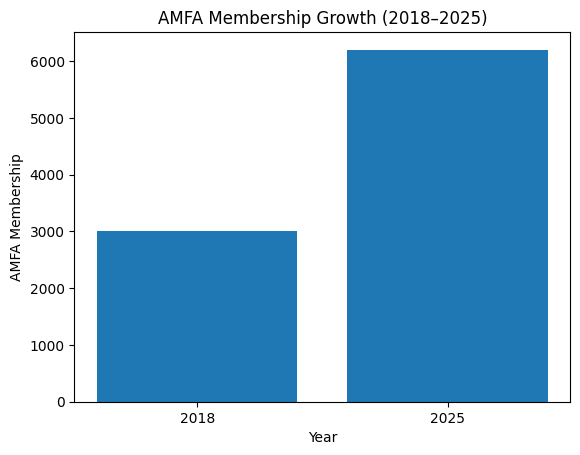
  • 2018-2025_Membership_Growth_Chart.png
    The heightened interest from other technician/engineer groups across the U.S. and Canada suggests that each high-profile contract functions as both a retention and a recruiting tool, contributing to approximately 83% membership growth since 2018.
  • Membership has expanded from just over 3,000 AMTs and related at Southwest and Alaska in 2018 to more than 6,200 by the end of 2025, with the addition of new members at Horizon, Spirit, Sun Country, L3 Harris (Trenton), WestJet, Calm Air, Jazz Aviation Line, and Jazz Technical Services. Once Aircraft Maintenance Technicians and Engineers at Hawaiian Airlines and Air Canada complete their representation votes and formally join AMFA, the union’s membership will have tripled compared to its 2018 size.
  • Ongoing campaigns at Alaska–Hawaiian and 2,200 Air Canada professionals, combined with recent CBAs that average around 30% wage increases and stronger job protections and bargaining outcomes have been central to AMFA’s membership growth because “industry-leading” contracts at key carriers created a reputation for higher pay and better quality of life that drew AMFA as a leading alternative to “catch-all” industrial unions and non-unionized workgroups.

Organizing Wins and Strong Contracts

  • New certifications and accretions at U.S. and Canadian carriers, plus maintenance and control groups, directly add members while showcasing AMFA’s bargaining results in multiple operations and countries.
  • Recent contracts at WestJet, Jazz Line/JTS, Calm Air, Horizon, and Alaska feature double-digit raises, improved work rules and benefits, and upgraded job protection and scope language, reinforcing AMFA’s reputation for securing top-tier economics.

Contract Gains and Wage Focus

  • Leadership emphasizes “industry-changing” contracts, with strategies to push represented carriers to leapfrog each other’s wage scales and improve quality of life; these high-profile gains make AMFA more attractive to non-union and other industrial union member groups.
  • The public highlights significant double-digit raises, seniority protections, and scheduling improvements achieved in recent CBAs, which support word-of-mouth growth among aircraft maintenance technicians and engineers.

Craft-Specific and Democratic Model

  • AMFA represents only AMTs/AMEs and skilled trade professionals, focusing 100% of union resources on a single craft and contrasting itself with industrial unions that spread attention across many sectors and classifications.
  • Direct election of national officers, open negotiations, and full access to tentative agreements before ratification give members transparency and control, which AMTs/AMEs cite as key reasons for moving to and staying with AMFA, which leaders cite when explaining why AMTs/AMEs are shifting to AMFA.

Wage Gains and Industry-Leading Deals

  • AMFA frequently highlights double-digit raises, high top-of-scale rates, and premium structures in recent CBAs at carriers such as Southwest, Alaska, Horizon, WestJet, Jazz Aviation Line/JTS, and Calm Air, framing these contracts as setting or matching the top of the market.
  • Historical examples, such as the Northwest Airlines CBA in early 2001 with hard the fought battle with NWA management and successful legal battle at mediation with the Presidential Emergency Board (PEB) that delivered an industry-changing contract resulting in significant $10-13 hourly wage increases with 37% raise top-of-scale, pension rate increase of 113%, retroactive pay rate of 3.5% of W-2 earnings, secured outsourcing limits (there were no outsourcing limits in the prior IAM-negotiated contract) and briefly led the industry, illustrates and reinforce a long pattern where strong economics reinforced members’ decisions to choose or stay with AMFA.

Scope, Outsourcing Limits, and Work Protection

  • At several AMFA properties, contract language governing vendor use and scheduled maintenance limits outsourcing and preserves core work – an important consideration for those concerned about job security and the erosion of in-house line maintenance. AMFA members understand outsourcing limits and protections because they directly shape that language through the contract proposal and ratification process, retaining final authority over scope, outsourcing limits, and work protection.
  • Critics from rival unions occasionally point to AMFA contracts as having weaker scope language; however, those attacks highlight how central scope protections, growth language, and clear voting information are when AMTs/AMEs and related skilled professionals evaluate which union best defends long-term job security. By contrast, industrial unions like IBT, TWU, and IAM frequently criticize AMFA while avoiding transparent disclosure to their own members about outsourcing, despite it remaining a significant issue at the carriers they represent.
  • According to the DOT Inspector General, major U.S. air carriers outsource approximately 71% of heavy airframe maintenance, with about 27% performed at foreign stations— meaning roughly one in five U.S. flights has undergone overseas maintenance. Network airlines remain the largest outsourcing spenders, with American Airlines paying providers ($1.9B), Delta ($1.1B), and United ($1.6B) leading in 2019; Southwest and JetBlue spent $837 million and $579 million, respectively.

Visibility and Organizing Leverage

  • National updates from AMFA emphasize that visible bargaining wins at existing carriers “raise the bar” on compensation and conditions across the sector, which in turn makes non-union or differently represented groups more receptive to AMFA organizing campaigns and open negotiation process.
  • AMFA leadership explicitly links major, ratified industry-changing CBAs to tangible gains for members, including job protections, top-of-scale wages, retroactive pay, and improved work-jurisdiction safeguards. Notable examples include Southwest (2019 and 2023: $160M retro pay, top wages, job protections), Alaska (2024: $65.85 top rate, OT protections), WestJet (2024: 27% wage increase, 20% matching retirement), Horizon (2025: 20% top-of-scale increase), Jazz Aviation Line/JTS (2025: 19–40% immediate wage increases, 63% average five-year progression), and Calm Air (2025: 22% first-year wage increase, comprehensive contract reorganization, strengthened subcontracting protections).
As we enter the new year, AMFA’s record demonstrates that a craft-specific, member-driven approach delivers tangible results: industry-leading wages, strong job protections, and transparent, democratic processes. These achievements not only reinforce the value of skilled AMTs/AMEs but also position AMFA as the benchmark for representation in aviation maintenance across North America. By continuing to set high standards at the bargaining table, AMFA ensures long-term security, career growth, and recognition for its members, while strengthening the union’s influence and appeal to new and existing professionals.
In solidarity,
Bret Oestreich
National President
[/td]​
-
[td width="357.062px"]

[/td]
 
Look here in this year end picture. There’s almost more Lawyers (The owners) then there are AMFA Members. What kind of grift does this outfit got going on? They don’t even look like Somali Day Care owners.

And that guy Ostrich. What the hell is his story?

View attachment 18112
Wrong again there skippy!!! There are more Mechanics than attorney's, and a matter fact there are also Mechanics within the group of attorney's that you circled, you big dummy. You are getting worse than the other 2 yahoo idiots now weez as you keep getting beat down to a pulp with the winnings of AMFA as of lately. That is called being THOROUGHLY represented, and covering all basis. BTW weezy, our Pilots have even more and probably double the attorneys, para's, assistants, and many other professionals to represent the Mechanics Class and Craft to the max ability they can. NOT the half a$$ representation you guys get from the twu-iam and of course the lazy and crooked teamsters. It's called REPRESENTATION 101. You cannot even come close to this kind of representation with the industrial unions I just listed, period skippy. Here's the factual accomplishments thru-out 2025 with AMFA's representation. "Where is the twu, iam, and ibt accomplishments for just one freakin year in 2025??? 🙂


************************************************************************************************
National President's Year-End Update - 2025
[td]
Dec 30, 2025
To:
Re:
Date:
AMFA Members
National President’s Year-End Update - 2025
December 31, 2025
Dear Members:
The start of a new year is always an opportunity to advance our goals, strengthen relationships, and build on the progress we have already made together as a craft-specific union. AMFA’s leadership remains fully committed to our core objective: upholding the highest standards of this industry, and our goal is to secure the recognition you deserve—from your employer, from regulators, and from the flying public—for the critical role our profession plays in aviation safety across North America.
We will continue to be the voice for skilled aircraft maintenance workgroups by driving top-of-scale wages at our represented carriers to within cents—not dollars—of one another, as the market responds to the true value of licensed AMT/AME skillsets. As AMFA raises top-of-scale all-in rates in the United States and Canada, the clear expectation is that other labor organizations will be forced to keep pace with the “AMFA Effect,” setting a new industry standard established by AMFA at the bargaining table.

Year-End Growth Snapshot

  • 2018-2025_Membership_Growth_Chart.png
    The heightened interest from other technician/engineer groups across the U.S. and Canada suggests that each high-profile contract functions as both a retention and a recruiting tool, contributing to approximately 83% membership growth since 2018.
  • Membership has expanded from just over 3,000 AMTs and related at Southwest and Alaska in 2018 to more than 6,200 by the end of 2025, with the addition of new members at Horizon, Spirit, Sun Country, L3 Harris (Trenton), WestJet, Calm Air, Jazz Aviation Line, and Jazz Technical Services. Once Aircraft Maintenance Technicians and Engineers at Hawaiian Airlines and Air Canada complete their representation votes and formally join AMFA, the union’s membership will have tripled compared to its 2018 size.
  • Ongoing campaigns at Alaska–Hawaiian and 2,200 Air Canada professionals, combined with recent CBAs that average around 30% wage increases and stronger job protections and bargaining outcomes have been central to AMFA’s membership growth because “industry-leading” contracts at key carriers created a reputation for higher pay and better quality of life that drew AMFA as a leading alternative to “catch-all” industrial unions and non-unionized workgroups.

Organizing Wins and Strong Contracts

  • New certifications and accretions at U.S. and Canadian carriers, plus maintenance and control groups, directly add members while showcasing AMFA’s bargaining results in multiple operations and countries.
  • Recent contracts at WestJet, Jazz Line/JTS, Calm Air, Horizon, and Alaska feature double-digit raises, improved work rules and benefits, and upgraded job protection and scope language, reinforcing AMFA’s reputation for securing top-tier economics.

Contract Gains and Wage Focus

  • Leadership emphasizes “industry-changing” contracts, with strategies to push represented carriers to leapfrog each other’s wage scales and improve quality of life; these high-profile gains make AMFA more attractive to non-union and other industrial union member groups.
  • The public highlights significant double-digit raises, seniority protections, and scheduling improvements achieved in recent CBAs, which support word-of-mouth growth among aircraft maintenance technicians and engineers.

Craft-Specific and Democratic Model

  • AMFA represents only AMTs/AMEs and skilled trade professionals, focusing 100% of union resources on a single craft and contrasting itself with industrial unions that spread attention across many sectors and classifications.
  • Direct election of national officers, open negotiations, and full access to tentative agreements before ratification give members transparency and control, which AMTs/AMEs cite as key reasons for moving to and staying with AMFA, which leaders cite when explaining why AMTs/AMEs are shifting to AMFA.

Wage Gains and Industry-Leading Deals

  • AMFA frequently highlights double-digit raises, high top-of-scale rates, and premium structures in recent CBAs at carriers such as Southwest, Alaska, Horizon, WestJet, Jazz Aviation Line/JTS, and Calm Air, framing these contracts as setting or matching the top of the market.
  • Historical examples, such as the Northwest Airlines CBA in early 2001 with hard the fought battle with NWA management and successful legal battle at mediation with the Presidential Emergency Board (PEB) that delivered an industry-changing contract resulting in significant $10-13 hourly wage increases with 37% raise top-of-scale, pension rate increase of 113%, retroactive pay rate of 3.5% of W-2 earnings, secured outsourcing limits (there were no outsourcing limits in the prior IAM-negotiated contract) and briefly led the industry, illustrates and reinforce a long pattern where strong economics reinforced members’ decisions to choose or stay with AMFA.

Scope, Outsourcing Limits, and Work Protection

  • At several AMFA properties, contract language governing vendor use and scheduled maintenance limits outsourcing and preserves core work – an important consideration for those concerned about job security and the erosion of in-house line maintenance. AMFA members understand outsourcing limits and protections because they directly shape that language through the contract proposal and ratification process, retaining final authority over scope, outsourcing limits, and work protection.
  • Critics from rival unions occasionally point to AMFA contracts as having weaker scope language; however, those attacks highlight how central scope protections, growth language, and clear voting information are when AMTs/AMEs and related skilled professionals evaluate which union best defends long-term job security. By contrast, industrial unions like IBT, TWU, and IAM frequently criticize AMFA while avoiding transparent disclosure to their own members about outsourcing, despite it remaining a significant issue at the carriers they represent.
  • According to the DOT Inspector General, major U.S. air carriers outsource approximately 71% of heavy airframe maintenance, with about 27% performed at foreign stations— meaning roughly one in five U.S. flights has undergone overseas maintenance. Network airlines remain the largest outsourcing spenders, with American Airlines paying providers ($1.9B), Delta ($1.1B), and United ($1.6B) leading in 2019; Southwest and JetBlue spent $837 million and $579 million, respectively.

Visibility and Organizing Leverage

  • National updates from AMFA emphasize that visible bargaining wins at existing carriers “raise the bar” on compensation and conditions across the sector, which in turn makes non-union or differently represented groups more receptive to AMFA organizing campaigns and open negotiation process.
  • AMFA leadership explicitly links major, ratified industry-changing CBAs to tangible gains for members, including job protections, top-of-scale wages, retroactive pay, and improved work-jurisdiction safeguards. Notable examples include Southwest (2019 and 2023: $160M retro pay, top wages, job protections), Alaska (2024: $65.85 top rate, OT protections), WestJet (2024: 27% wage increase, 20% matching retirement), Horizon (2025: 20% top-of-scale increase), Jazz Aviation Line/JTS (2025: 19–40% immediate wage increases, 63% average five-year progression), and Calm Air (2025: 22% first-year wage increase, comprehensive contract reorganization, strengthened subcontracting protections).
As we enter the new year, AMFA’s record demonstrates that a craft-specific, member-driven approach delivers tangible results: industry-leading wages, strong job protections, and transparent, democratic processes. These achievements not only reinforce the value of skilled AMTs/AMEs but also position AMFA as the benchmark for representation in aviation maintenance across North America. By continuing to set high standards at the bargaining table, AMFA ensures long-term security, career growth, and recognition for its members, while strengthening the union’s influence and appeal to new and existing professionals.
In solidarity,
Bret Oestreich
National President
[/td]​
-
[td width="357.062px"]

[/td]
 
AMFA DOES NOT SUCK!!!!!

View attachment 18113
Yup! It's official, wezy has completely lost it as shown by this pic taken by the room camera.
And again I share with you WHY, as you just stated, AMFA does not suck. You are finally just starting to realize reality there weezy, you are starting to show some progress:-


************************************************************************************************
National President's Year-End Update - 2025
[td]
Dec 30, 2025
To:
Re:
Date:
AMFA Members
National President’s Year-End Update - 2025
December 31, 2025
Dear Members:
The start of a new year is always an opportunity to advance our goals, strengthen relationships, and build on the progress we have already made together as a craft-specific union. AMFA’s leadership remains fully committed to our core objective: upholding the highest standards of this industry, and our goal is to secure the recognition you deserve—from your employer, from regulators, and from the flying public—for the critical role our profession plays in aviation safety across North America.
We will continue to be the voice for skilled aircraft maintenance workgroups by driving top-of-scale wages at our represented carriers to within cents—not dollars—of one another, as the market responds to the true value of licensed AMT/AME skillsets. As AMFA raises top-of-scale all-in rates in the United States and Canada, the clear expectation is that other labor organizations will be forced to keep pace with the “AMFA Effect,” setting a new industry standard established by AMFA at the bargaining table.

Year-End Growth Snapshot

  • 2018-2025_Membership_Growth_Chart.png
    The heightened interest from other technician/engineer groups across the U.S. and Canada suggests that each high-profile contract functions as both a retention and a recruiting tool, contributing to approximately 83% membership growth since 2018.
  • Membership has expanded from just over 3,000 AMTs and related at Southwest and Alaska in 2018 to more than 6,200 by the end of 2025, with the addition of new members at Horizon, Spirit, Sun Country, L3 Harris (Trenton), WestJet, Calm Air, Jazz Aviation Line, and Jazz Technical Services. Once Aircraft Maintenance Technicians and Engineers at Hawaiian Airlines and Air Canada complete their representation votes and formally join AMFA, the union’s membership will have tripled compared to its 2018 size.
  • Ongoing campaigns at Alaska–Hawaiian and 2,200 Air Canada professionals, combined with recent CBAs that average around 30% wage increases and stronger job protections and bargaining outcomes have been central to AMFA’s membership growth because “industry-leading” contracts at key carriers created a reputation for higher pay and better quality of life that drew AMFA as a leading alternative to “catch-all” industrial unions and non-unionized workgroups.

Organizing Wins and Strong Contracts

  • New certifications and accretions at U.S. and Canadian carriers, plus maintenance and control groups, directly add members while showcasing AMFA’s bargaining results in multiple operations and countries.
  • Recent contracts at WestJet, Jazz Line/JTS, Calm Air, Horizon, and Alaska feature double-digit raises, improved work rules and benefits, and upgraded job protection and scope language, reinforcing AMFA’s reputation for securing top-tier economics.

Contract Gains and Wage Focus

  • Leadership emphasizes “industry-changing” contracts, with strategies to push represented carriers to leapfrog each other’s wage scales and improve quality of life; these high-profile gains make AMFA more attractive to non-union and other industrial union member groups.
  • The public highlights significant double-digit raises, seniority protections, and scheduling improvements achieved in recent CBAs, which support word-of-mouth growth among aircraft maintenance technicians and engineers.

Craft-Specific and Democratic Model

  • AMFA represents only AMTs/AMEs and skilled trade professionals, focusing 100% of union resources on a single craft and contrasting itself with industrial unions that spread attention across many sectors and classifications.
  • Direct election of national officers, open negotiations, and full access to tentative agreements before ratification give members transparency and control, which AMTs/AMEs cite as key reasons for moving to and staying with AMFA, which leaders cite when explaining why AMTs/AMEs are shifting to AMFA.

Wage Gains and Industry-Leading Deals

  • AMFA frequently highlights double-digit raises, high top-of-scale rates, and premium structures in recent CBAs at carriers such as Southwest, Alaska, Horizon, WestJet, Jazz Aviation Line/JTS, and Calm Air, framing these contracts as setting or matching the top of the market.
  • Historical examples, such as the Northwest Airlines CBA in early 2001 with hard the fought battle with NWA management and successful legal battle at mediation with the Presidential Emergency Board (PEB) that delivered an industry-changing contract resulting in significant $10-13 hourly wage increases with 37% raise top-of-scale, pension rate increase of 113%, retroactive pay rate of 3.5% of W-2 earnings, secured outsourcing limits (there were no outsourcing limits in the prior IAM-negotiated contract) and briefly led the industry, illustrates and reinforce a long pattern where strong economics reinforced members’ decisions to choose or stay with AMFA.

Scope, Outsourcing Limits, and Work Protection

  • At several AMFA properties, contract language governing vendor use and scheduled maintenance limits outsourcing and preserves core work – an important consideration for those concerned about job security and the erosion of in-house line maintenance. AMFA members understand outsourcing limits and protections because they directly shape that language through the contract proposal and ratification process, retaining final authority over scope, outsourcing limits, and work protection.
  • Critics from rival unions occasionally point to AMFA contracts as having weaker scope language; however, those attacks highlight how central scope protections, growth language, and clear voting information are when AMTs/AMEs and related skilled professionals evaluate which union best defends long-term job security. By contrast, industrial unions like IBT, TWU, and IAM frequently criticize AMFA while avoiding transparent disclosure to their own members about outsourcing, despite it remaining a significant issue at the carriers they represent.
  • According to the DOT Inspector General, major U.S. air carriers outsource approximately 71% of heavy airframe maintenance, with about 27% performed at foreign stations— meaning roughly one in five U.S. flights has undergone overseas maintenance. Network airlines remain the largest outsourcing spenders, with American Airlines paying providers ($1.9B), Delta ($1.1B), and United ($1.6B) leading in 2019; Southwest and JetBlue spent $837 million and $579 million, respectively.

Visibility and Organizing Leverage

  • National updates from AMFA emphasize that visible bargaining wins at existing carriers “raise the bar” on compensation and conditions across the sector, which in turn makes non-union or differently represented groups more receptive to AMFA organizing campaigns and open negotiation process.
  • AMFA leadership explicitly links major, ratified industry-changing CBAs to tangible gains for members, including job protections, top-of-scale wages, retroactive pay, and improved work-jurisdiction safeguards. Notable examples include Southwest (2019 and 2023: $160M retro pay, top wages, job protections), Alaska (2024: $65.85 top rate, OT protections), WestJet (2024: 27% wage increase, 20% matching retirement), Horizon (2025: 20% top-of-scale increase), Jazz Aviation Line/JTS (2025: 19–40% immediate wage increases, 63% average five-year progression), and Calm Air (2025: 22% first-year wage increase, comprehensive contract reorganization, strengthened subcontracting protections).
As we enter the new year, AMFA’s record demonstrates that a craft-specific, member-driven approach delivers tangible results: industry-leading wages, strong job protections, and transparent, democratic processes. These achievements not only reinforce the value of skilled AMTs/AMEs but also position AMFA as the benchmark for representation in aviation maintenance across North America. By continuing to set high standards at the bargaining table, AMFA ensures long-term security, career growth, and recognition for its members, while strengthening the union’s influence and appeal to new and existing professionals.
In solidarity,
Bret Oestreich
National President
[/td]​
-
[td width="357.062px"]

[/td]
 
So the IAM is saying that AMFA is claiming they won an Arbitration Award that brought work back in House that they can’t find.

I’m sure Swamp will prove them wrong and share that Arbitration Award right here on this Forums.

 
Tag, you’re it fruitloop.

View attachment 18115
Wrong again my little *****. The title alone in the heading says all the lies itself and drives everyone to NOT view or listen to the crap you are posting weezy. Pls keep trying as YOU are doing a fantastic job for recruiting AMFA for all the Mechanics Class and Craft in the ENTIRE airline industry...
 
So the IAM is saying that AMFA is claiming they won an Arbitration Award that brought work back in House that they can’t find.

I’m sure Swamp will prove them wrong and share that Arbitration Award right here on this Forums.


Wow! Really weezy?? Are you serious?? I will NOT do the homework for you no longer as you know. YOU are just asking me to do what you already know. Nice try my little *****...
 
Here's a little reminder my little *****! Read'em and weep-


************************************************************************************************
National President's Year-End Update - 2025
[td]
Dec 30, 2025
To:
Re:
Date:
AMFA Members
National President’s Year-End Update - 2025
December 31, 2025
Dear Members:
The start of a new year is always an opportunity to advance our goals, strengthen relationships, and build on the progress we have already made together as a craft-specific union. AMFA’s leadership remains fully committed to our core objective: upholding the highest standards of this industry, and our goal is to secure the recognition you deserve—from your employer, from regulators, and from the flying public—for the critical role our profession plays in aviation safety across North America.
We will continue to be the voice for skilled aircraft maintenance workgroups by driving top-of-scale wages at our represented carriers to within cents—not dollars—of one another, as the market responds to the true value of licensed AMT/AME skillsets. As AMFA raises top-of-scale all-in rates in the United States and Canada, the clear expectation is that other labor organizations will be forced to keep pace with the “AMFA Effect,” setting a new industry standard established by AMFA at the bargaining table.

Year-End Growth Snapshot

  • 2018-2025_Membership_Growth_Chart.png
    The heightened interest from other technician/engineer groups across the U.S. and Canada suggests that each high-profile contract functions as both a retention and a recruiting tool, contributing to approximately 83% membership growth since 2018.
  • Membership has expanded from just over 3,000 AMTs and related at Southwest and Alaska in 2018 to more than 6,200 by the end of 2025, with the addition of new members at Horizon, Spirit, Sun Country, L3 Harris (Trenton), WestJet, Calm Air, Jazz Aviation Line, and Jazz Technical Services. Once Aircraft Maintenance Technicians and Engineers at Hawaiian Airlines and Air Canada complete their representation votes and formally join AMFA, the union’s membership will have tripled compared to its 2018 size.
  • Ongoing campaigns at Alaska–Hawaiian and 2,200 Air Canada professionals, combined with recent CBAs that average around 30% wage increases and stronger job protections and bargaining outcomes have been central to AMFA’s membership growth because “industry-leading” contracts at key carriers created a reputation for higher pay and better quality of life that drew AMFA as a leading alternative to “catch-all” industrial unions and non-unionized workgroups.

Organizing Wins and Strong Contracts

  • New certifications and accretions at U.S. and Canadian carriers, plus maintenance and control groups, directly add members while showcasing AMFA’s bargaining results in multiple operations and countries.
  • Recent contracts at WestJet, Jazz Line/JTS, Calm Air, Horizon, and Alaska feature double-digit raises, improved work rules and benefits, and upgraded job protection and scope language, reinforcing AMFA’s reputation for securing top-tier economics.

Contract Gains and Wage Focus

  • Leadership emphasizes “industry-changing” contracts, with strategies to push represented carriers to leapfrog each other’s wage scales and improve quality of life; these high-profile gains make AMFA more attractive to non-union and other industrial union member groups.
  • The public highlights significant double-digit raises, seniority protections, and scheduling improvements achieved in recent CBAs, which support word-of-mouth growth among aircraft maintenance technicians and engineers.

Craft-Specific and Democratic Model

  • AMFA represents only AMTs/AMEs and skilled trade professionals, focusing 100% of union resources on a single craft and contrasting itself with industrial unions that spread attention across many sectors and classifications.
  • Direct election of national officers, open negotiations, and full access to tentative agreements before ratification give members transparency and control, which AMTs/AMEs cite as key reasons for moving to and staying with AMFA, which leaders cite when explaining why AMTs/AMEs are shifting to AMFA.

Wage Gains and Industry-Leading Deals

  • AMFA frequently highlights double-digit raises, high top-of-scale rates, and premium structures in recent CBAs at carriers such as Southwest, Alaska, Horizon, WestJet, Jazz Aviation Line/JTS, and Calm Air, framing these contracts as setting or matching the top of the market.
  • Historical examples, such as the Northwest Airlines CBA in early 2001 with hard the fought battle with NWA management and successful legal battle at mediation with the Presidential Emergency Board (PEB) that delivered an industry-changing contract resulting in significant $10-13 hourly wage increases with 37% raise top-of-scale, pension rate increase of 113%, retroactive pay rate of 3.5% of W-2 earnings, secured outsourcing limits (there were no outsourcing limits in the prior IAM-negotiated contract) and briefly led the industry, illustrates and reinforce a long pattern where strong economics reinforced members’ decisions to choose or stay with AMFA.

Scope, Outsourcing Limits, and Work Protection

  • At several AMFA properties, contract language governing vendor use and scheduled maintenance limits outsourcing and preserves core work – an important consideration for those concerned about job security and the erosion of in-house line maintenance. AMFA members understand outsourcing limits and protections because they directly shape that language through the contract proposal and ratification process, retaining final authority over scope, outsourcing limits, and work protection.
  • Critics from rival unions occasionally point to AMFA contracts as having weaker scope language; however, those attacks highlight how central scope protections, growth language, and clear voting information are when AMTs/AMEs and related skilled professionals evaluate which union best defends long-term job security. By contrast, industrial unions like IBT, TWU, and IAM frequently criticize AMFA while avoiding transparent disclosure to their own members about outsourcing, despite it remaining a significant issue at the carriers they represent.
  • According to the DOT Inspector General, major U.S. air carriers outsource approximately 71% of heavy airframe maintenance, with about 27% performed at foreign stations— meaning roughly one in five U.S. flights has undergone overseas maintenance. Network airlines remain the largest outsourcing spenders, with American Airlines paying providers ($1.9B), Delta ($1.1B), and United ($1.6B) leading in 2019; Southwest and JetBlue spent $837 million and $579 million, respectively.

Visibility and Organizing Leverage

  • National updates from AMFA emphasize that visible bargaining wins at existing carriers “raise the bar” on compensation and conditions across the sector, which in turn makes non-union or differently represented groups more receptive to AMFA organizing campaigns and open negotiation process.
  • AMFA leadership explicitly links major, ratified industry-changing CBAs to tangible gains for members, including job protections, top-of-scale wages, retroactive pay, and improved work-jurisdiction safeguards. Notable examples include Southwest (2019 and 2023: $160M retro pay, top wages, job protections), Alaska (2024: $65.85 top rate, OT protections), WestJet (2024: 27% wage increase, 20% matching retirement), Horizon (2025: 20% top-of-scale increase), Jazz Aviation Line/JTS (2025: 19–40% immediate wage increases, 63% average five-year progression), and Calm Air (2025: 22% first-year wage increase, comprehensive contract reorganization, strengthened subcontracting protections).
As we enter the new year, AMFA’s record demonstrates that a craft-specific, member-driven approach delivers tangible results: industry-leading wages, strong job protections, and transparent, democratic processes. These achievements not only reinforce the value of skilled AMTs/AMEs but also position AMFA as the benchmark for representation in aviation maintenance across North America. By continuing to set high standards at the bargaining table, AMFA ensures long-term security, career growth, and recognition for its members, while strengthening the union’s influence and appeal to new and existing professionals.
In solidarity,
Bret Oestreich
National President
[/td]​
-
[td width="357.062px"]
 

Latest posts

Back
Top